

programming a binary options bot
In this weblog: Use Python to visualize your stock holdings, and so build a trading bot to buy/sell your stocks with our Pre-congenital Trading Bot runtime.
Recent trends in the global stock markets due to the current COVID-xix pandemic have been far from stable…and far from certain. The last fourth dimension the market was this tumultuous, many people in the United states of america and abroad lost a lot of coin. But a few were fortunate enough to put themselves in a position to profit. The current situation volition be no different.
Whether you are a seasoned programmer only getting started with financial trading, or an experienced investor interested in discovering the power of Python, this article is for you. In it, I'll demonstrate how Python can be used to visualize holdings in your electric current fiscal portfolio, as well as how to build a trading bot governed by a simple conditional-based algorithm.
Installing Python for Trading Bots
To follow along with the code in this commodity, you lot'll need to have a recent version of Python installed. I'll exist using a custom build ofActivePython that includes a version of Python and just the packages the projection requires. You lot tin get a re-create for yourself by doing the post-obit:
- Download and install the "Trading Bot" runtime by doing the following:
- Install the Country Tool on Windows using Powershell:
IEX(New-Object Net.WebClient).downloadString('https://platform.activestate.com/dl/cli/install.ps1')Or install Country Tool on Linux or Mac:
sh <(curl -q https://platform.activestate.com/dl/cli/install.sh) - Run the following control to download the build and automatically install information technology into a virtual surroundings:
state activate Pizza-Squad/Trading-Bot
- Install the Country Tool on Windows using Powershell:
You tin can observe all of the code used in this article in my GitLab repository.
All fix? Permit's dive into the details.
Financial Data for Trading Bots
There are many unlike stock trading platforms out there, some with their ain APIs. Robinhood offers a commision-free investing platform that makes trading uncomplicated and easy. Additionally, the robin–stocks bundle extends this simplicity over to Python, supporting features like stock trading, buy/sell options, and purchase cryptocurrencies, as well as giving access to existent-time portfolio and market performance.
To follow along with this postal service, yous'll need to create a Robinhood account. Note that if yous're located outside the The states, you'll demand to use another trading platform. In this case, the structure of the trading bot will be the same, but how yous execute the trades will be different.
To go started, we'll first import the packages we demand and and so log in to the Robinhood platform. Supervene upon the username and password strings with your own account information:
import robin_stocks every bit r import pandas as pd import fourth dimension username = 'user@post.com' password = 'countersign' login = r.login(username,countersign)
Depending on your security settings, yous may crave ii-factor authentication. In one case logged in, you can easily access your holdings by running:
r.build_holdings()
The output is a dictionary that looks something like this:
{'KMI' : {'price' : 'thirteen.990000', 'quantity' : 'i.00000000', 'average_buy_price' : '0.000', 'equity' : 'thirteen.99', 'percent_change' : '0.00', 'equity_change' : '13.990000', 'type' : 'stock', 'proper noun' : 'Kinder Morgan', 'id' : '346c3dc3-2ef4-470f-aa67-0471cffeb299', 'pe_ratio' : '13.939700', 'pct' : '100.00'}} Of class, for bigger portfolios the output volition exist much longer. You can also access any of your profile information through the profiles module:
r.profiles.load_basic_profile()
There are a few more informative functions that tin be used to extract information about your profile. They tin can be found in the documentation here.
Before we get to buying and selling, it is useful to build a visualization tool to discover historical changes in a given stock. The get-go thing I do is build a visualize_price() role that does exactly that.
The input is a list of tickers to plot, the time menstruation over which to plot them (can exist either day, week, calendar month, 3month, year, or 5year), and whether to include extended trading hours or but regular trading hours (can be extended or regular).
def visualize_price(ticker_list, span = 'yr', bounds = 'regular'): for t in range(len(ticker_list)): proper noun = str(r.get_name_by_symbol(ticker_list[t])) hist = r.stocks.get_historicals(ticker_list[t], span=span, bounds=bounds) hist_df = pd.DataFrame() for i in range(len(hist)): df = pd.DataFrame(hist[i], index = [i]) hist_df = pd.concat([hist_df,df]) hist_df.begins_at = pd.to_datetime(hist_df.begins_at, infer_datetime_format=True) hist_df.open_price = hist_df.open_price.astype('float32') hist_df.close_price = hist_df.close_price.astype('float32') hist_df.high_price = hist_df.high_price.astype('float32') hist_df.low_price = hist_df.low_price.astype('float32') ax = hist_df.plot(10 = 'begins_at', y = 'open_price', figsize = (sixteen,viii)) ax.fill_between(hist_df.begins_at, hist_df.low_price, hist_df.high_price, alpha=0.5) ax.set_xlabel('Date') ax.set_ylabel('Price (USD)') ax.legend([ticker_list[t]]) ax.set_title(proper name) return Y'all tin can customize the input ticker list, or utilise the function beneath to extract them from your holdings:
def extract_list(): ticker_list = listing(r.build_holdings().keys()) return ticker_list
To run the functions:
ticker_list = extract_list() visualize_price(ticker_list, span = 'year', premises = 'regular')
Since I only have one stock in my holdings, only one plot is given. The plot looks like this:
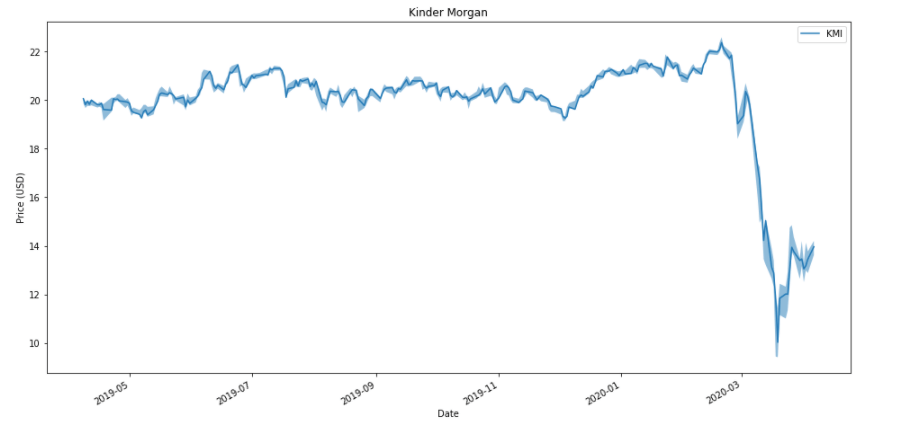
In add-on to plotting the opening price at each time interval (dark blue line), I've included the high and low cost over the same time interval (calorie-free blue).
Trading Bot Buy/Sell Code
Ideally, the trading bot should look at a predefined prepare of tickers within the portfolio and decide whether to buy, sell, or hold. The information that the bot uses to make this decision can be anything from how the price changes in a given time catamenia to the sentiment analysis of a tweet from the CEO of the company.
While there are many factors that tin can be taken into account, resulting in more sophisticated models for determining the bot conditionals, the base of operations functionality of the bot doesn't change. In our case, I'm merely using the percent_change aspect for each holding to determine whether or not to buy or sell. If the stock price has a drib over a certain percentage the bot will execute a buy. Conversely, if the stock price has a ascension over a sure pct the bot will execute a sell. To implement this behavior, I've defined a trading_bot function:
def trading_bot(trading_dict): holdings = r.build_holdings() holdings_df = pd.DataFrame() for i in range(len(holdings)): ticker = list(holdings.items())[i][0] holding_df = pd.DataFrame(listing(holdings.items())[i][ane], alphabetize = [i]) holding_df['ticker'] = ticker holdings_df = pd.concat([holdings_df, holding_df]) holdings_df = holdings_df[['ticker', 'price', 'quantity', 'percent_change','average_buy_price', 'equity', 'equity_change','pe_ratio', 'type', 'proper noun', 'id' ]] for j in range(len(trading_dict)): holding_df = holdings_df[holdings_df.ticker == listing(trading_dict.keys())[j]] if holding_df['percent_change'].astype('float32')[0] <= list(trading_dict.values())[j][0]: buy_string = 'Buying ' + str(holding_df['ticker'][0]) + ' at ' + time.ctime() print(buy_string) r.orders.order_buy_market(holding_df['ticker'][0],one,timeInForce= 'gfd') else: print('Nothing to buy') if holding_df['percent_change'].astype('float32')[0] >= list(trading_dict.values())[j][1]: sell_string = 'Ownership ' + str(holding_df['ticker'][0]) + ' at ' + fourth dimension.ctime() print(sell_string) r.orders.order_sell_market(holding_df['ticker'][0],ane,timeInForce= 'gfd') else: print('Nada to sell') Kickoff, the bot pulls the holdings from the Robinhood platform and does some restructuring of the data to create a pandas dataframe. Then, information technology loops through each ticker present in trading_dict and compares the percent_change value to the buy and sell conditional limits. For example, I tin set both limits to 0.5%:
trading_dict = {'KMI': [-0.50, 0.50]} holdings_df = trading_bot(trading_dict) The bot will then execute a buy or sell if the percent_change value is less than or greater than half a per centum, and prints out the transaction for each holding. Pretty cool correct?
That's it! You tin can now build your ain trading bot using Python
In this article, I demonstrated how Python can be used to build a simple trading bot using packages like pandas and robin-stocks. Past taking reward of the Robinhood trading platform, you tin can easily visualize the functioning of individual holdings within your portfolio.
The buy and sell atmospheric condition we set for the bot are relatively simplistic, simply this code provides the building blocks for creating a more than sophisticated algorithm. The versatility of Python offers the perfect playground for increasing the complexity by, for example, introducing car learning techniques and other financial metrics. I leave these side by side steps to those readers interested in creating a more than avant-garde bot.
- All of the lawmaking used in this commodity can be establish in my GitLab repository.
- Sign upwardly for a complimentary ActiveState Platform account and then you can download the Trading Bot runtime environment and build your very own trading bot
Recommended Reads
ActiveState Platform: How to Build a Custom Runtime in 5 minutes?
How to Build a Blockchain in Python (Get Pre-congenital Runtime)
Tiptop 10 Python Packages for Finance and Fiscal Modeling

Source: https://www.activestate.com/blog/how-to-build-an-algorithmic-trading-bot/
Posted by: santiagoprabile.blogspot.com
0 Response to "programming a binary options bot"
Post a Comment